Tadashi
Kawamata
Tadashi Kawamata is an artist who transforms our environment,
he works in the midst of demolition and construction. These projects
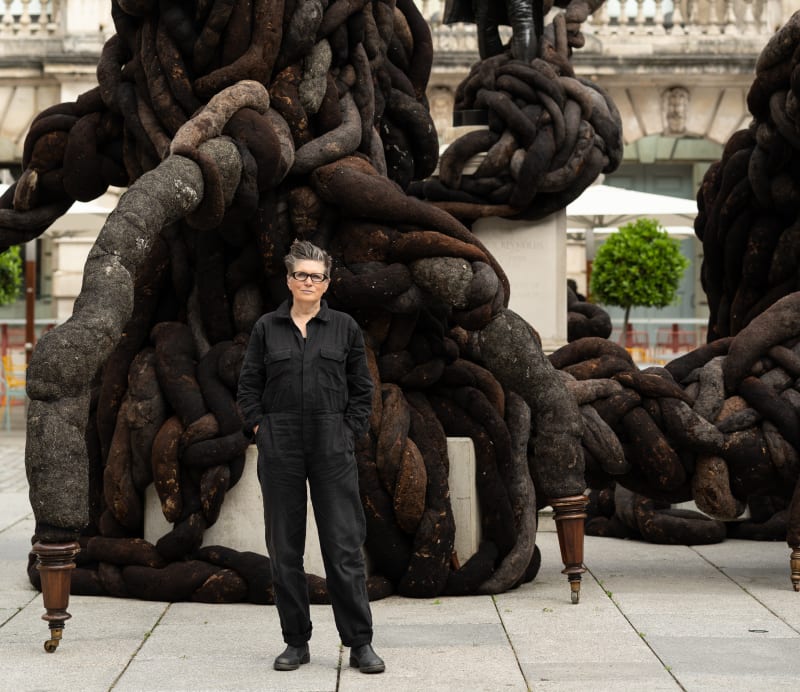
have taken place all over the world and range from intimate transformations
of a single house or apartment to the whole scale reconfiguration of
towns.
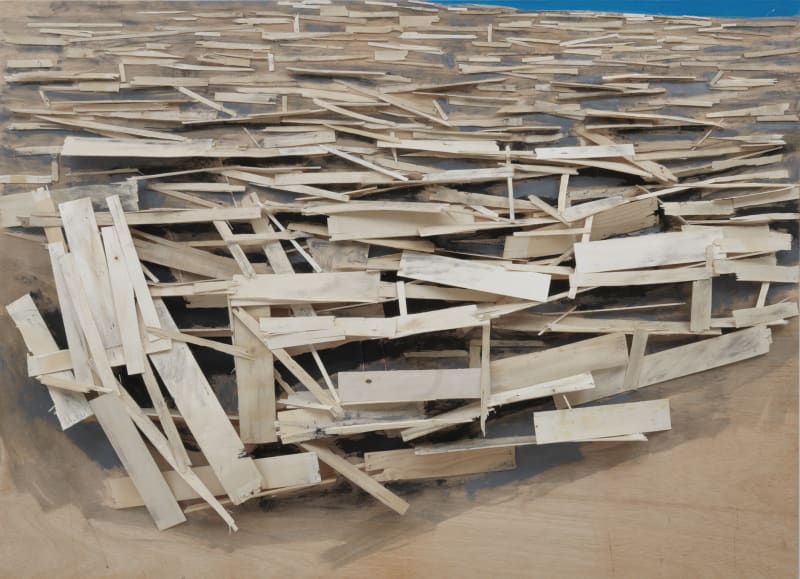
Usually using scrap or reclaimed materials, mostly wood, Kawamata sets
about building new and unusual structures; a bridge between an apartment
block and a museum, a wooden walkway that leads from a town centre to
a lakeside, slum dwellings constructed in a picturesque park. Kawamata's
aim is to turn these environments inside out, and present the viewers
with a completely fresh view of their surroundings, whether it's from
a walkway built three metres above the town square or by a room transformed
with a suspended ceiling of reclaimed doors. These projects make us question
our environment, the way it is constructed and how we interact with it.
Born in Hokkaido, Japan in 1953, this
is Tadashi KawamataÕs
third exhibition with Annely Juda Fine Art. He has had many one-man exhibitions
and projects throughout Europe, the United States and Japan including
the Serpentine Gallery, London, the Kunsthalle, Recklinghausen and the
Meguro Museum of Art, Tokyo. Tadashi Kawamata exhibited at the 40th Venice
Biennale in 1982, and later was invited to Documenta VIII and Documenta
IX . This autumn he will be participating in the Busan Biennale, Korea
Tadashi Kawamata talking about his projects;
CONSTRUCTION SITE PROJECTS
"Building sites are always in the midst of demolition and construction.
The processes are temporary and on-going. The fact that there are such sites
in every town and city means that there is one large cycle. Through these projects
at temporary building sites I feel I am able to express the endless cycle of
demolition and construction."
URBAN PROJECTS
" These projects invoke a larger urban area
than used in other projects. I try to consider the significance of
the project site in terms of considerations such as the history of
the area and the life of the people who live there."

|